MINE BITCOIN FROM HOME WITHOUT LOSING MONEY
Get the free Home Mining Setup Checklist — the ten things to work out before you buy a single machine — and join the waiting list for The Profitable Miner's Playbook.
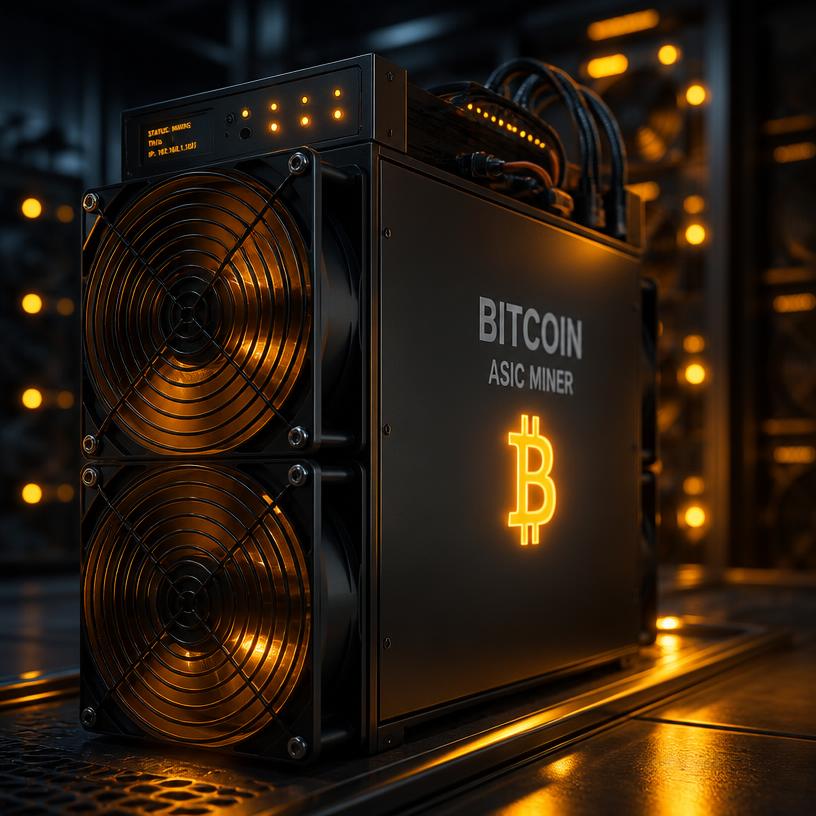
Most first-time home miners lose money in the first ninety days.
Not because mining doesn't work — because the setup decisions were made in the wrong order. The machine gets bought before the power rate is understood. The circuit trips. The noise makes the room unusable. The payouts land in an exchange account instead of a wallet. By the time the numbers are checked, the margin is gone.
- ×Buying hardware before modelling break-even
- ×Underestimating amperage and tripping breakers
- ×No plan for heat or noise in a lived-in house
- ×Choosing a pool and payout scheme at random
Why mine at all, when you could just buy?
Three reasons home mining still makes sense — financial, structural, and physical.
Financial incentives & revenue streams
Earn the block reward
Miners who find a block receive newly issued bitcoin plus the fees inside that block. That is the base revenue line every home rig plugs into.
Accumulating vs. buying
Mining is a second way to acquire BTC. Your effective cost per coin is set by your electricity rate and hardware efficiency, not by the market price on the day.
Transaction fees
Fees are a real and growing share of miner revenue, and they climb during periods of heavy on-chain demand.
Network security & individual sovereignty
You become the defensive layer
Every active miner adds to Bitcoin's proof-of-work, making an attack on the network more expensive.
Decentralisation
Home miners spread hash power across many independent locations instead of a handful of industrial sites.
Tools for sovereignty
Modern protocols such as Stratum V2 let miners build their own block templates rather than accepting a pool's.
The dual-utility economic edge
Heat you were paying for anyway
An ASIC converts electricity into heat. Used as a space heater in the months you'd heat the room regardless, the real cost of mining drops sharply.
Flexible load
Miners can be powered down in seconds, which makes them an interruptible load rather than a fixed draw on your supply.
Otherwise-wasted energy
Excess solar, off-peak capacity, or stranded gas can be turned into hash rate instead of being curtailed.
The Home Mining Setup Checklist
Ten steps, in order, from working out your real cost per kilowatt-hour to getting your first payout into a wallet you control. Join the waiting list and it's yours immediately.
- →Your true cost per kWh — the number everything else depends on
- →The amperage check that prevents a tripped breaker
- →A buyer's inspection list for second-hand ASICs
- →Airflow and noise layouts that work in a normal house
- →Pool setup and self-custody payouts, step by step
Get it now
Enter your email, click the verification link we send, and the checklist is yours.
Master the machine. Control the hash.
Hashrate & difficulty, decoded
The math behind the money — in plain language, so you know exactly what your machine is doing.
Your true cost per kilowatt-hour
Read your bill properly, find your off-peak windows, and model break-even before you buy.
Choosing your first miner
Matching efficiency, wattage, and price to your home's actual electrical capacity.
The second-hand market
How to buy used hardware without getting scammed, and what to inspect on arrival.
Electrical safety & circuits
Amperage, breakers, dedicated circuits, and when to call a licensed electrician.
Airflow and heat
Intake, exhaust, and duct layouts that keep a rig stable in a garage or spare room.
Noise management
Immersion, shrouds, fan swaps, and enclosures — with realistic decibel expectations.
Firmware & tuning
Underclocking and undervolting for efficiency instead of chasing raw hashrate.
Pool selection
Payout schemes compared, and how to configure your worker correctly.
Custody & payouts
Getting mined BTC into a wallet whose keys you actually hold.
Monitoring & uptime
Alerts, dashboards, and the weekly checks that catch problems early.
Records & tax
What to log from day one so filing season isn't a reconstruction project.
Before you ask
Do I need technical experience?+
No. The course assumes you have never configured a miner. Every step is shown end to end, and the jargon is explained the first time it appears.
How much does it cost to start?+
It depends on your hardware choice and power rate — which is exactly what Modules 02 and 03 make you calculate before you spend anything. The checklist walks you through the same numbers for free.
Will this wreck my electricity bill?+
Mining is only profitable when your power cost supports it. You'll model your break-even rate first, and learn where the heat output can offset heating you're already paying for.
Is it too loud for a house?+
A stock ASIC is genuinely loud. Module 07 covers the practical ways people run rigs in garages, basements, and outbuildings without upsetting the household.
Isn't it too late to start mining?+
Home mining is not about competing with industrial farms on scale. It's about your own cost structure — cheap or surplus power, heat reuse, and efficient hardware.
When does the course open?+
Enrollment opens to the waiting list first. Joining costs nothing and gets you the checklist immediately plus the early-bird price when doors open.
START WITH THE CHECKLIST.
Join the waiting list to get the Home Mining Setup Checklist now, plus first access and the early-bird price when enrollment opens.